Driver guides
What to Do When Your EV Runs Out of Charge: A Step-by-Step Guide
Your electric car is at 0%. Here is exactly what to do: get safe, check your real options, and get charged on the spot or towed the right way.
By the ChargePatrol team · Updated · 2 min read
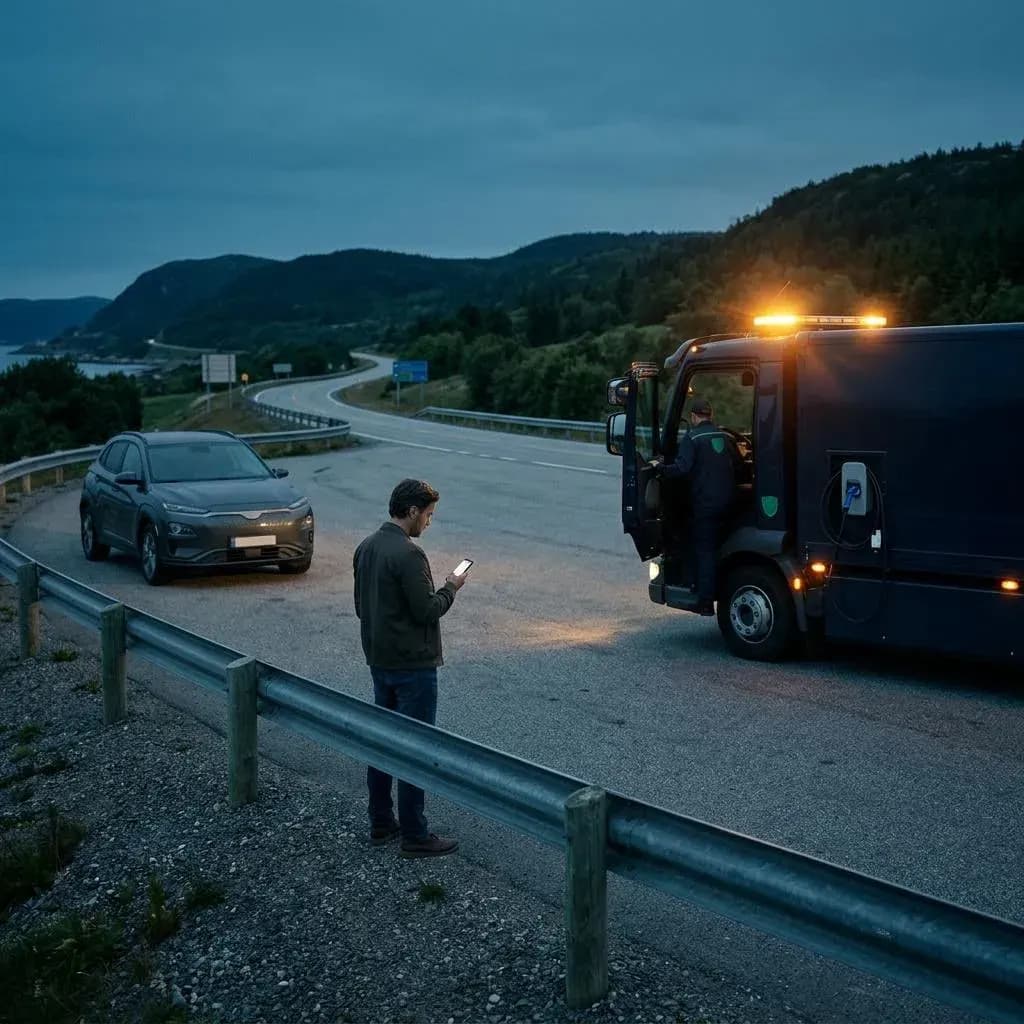
Running out of charge in an electric vehicle feels different from running out of gas. There is no can of fuel to carry back, and many drivers are not sure whether a tow is their only option. The good news: most EVs give plenty of warning, and when the battery does run out, you have more options than you might think.
1. Get to a safe place first
Most EVs do not stop instantly at 0%. Many enter a reduced-power mode (sometimes called turtle mode) that gives you a short distance at low speed. Use it to leave live traffic lanes.
- Signal and move to the shoulder, an exit ramp or a parking lot.
- Turn on your hazard lights.
- If you are stopped in a dangerous spot on a highway, get yourself to safety and call 911 before anything else.
- Do not stand between your car and traffic.
2. Put the car in Park and note what the screen says
Write down the battery percentage, any warning messages and whether the car still powers on. This tells a dispatcher whether you need energy, a 12V boost or a tow. A car with a black screen and locked doors may actually have a dead 12V battery, not an empty main battery.
3. Know your real options
Mobile charging is usually the fastest way back on the road because you skip the tow, the wait at the destination charger and the second trip to pick up your car.
- Mobile charging: a technician brings a DC fast charging unit to your car and adds enough range to reach a station or get home.
- A 12V jump-start: if the car will not wake up, unlock or shift, a 12V boost often fixes it in minutes.
- EV-safe flatbed towing: if the car has a fault, damage, or cannot be charged where it sits, it should be transported on a flatbed with all wheels off the ground.
4. Call for help with the right details
When you call ChargePatrol at 281-473-1221, have this ready:
- Your exact location: address, cross-street, exit number or mile marker
- Year, make and model of your EV
- Battery percentage and any warning messages
- Access notes: parking garage level, gate codes, height clearance
5. While you wait
Stay with the vehicle if it is safe to do so. Avoid running climate control at full power if the car still has a sliver of charge. Keep your phone charged and answer calls from the dispatcher, who may need to confirm your location.
How to avoid running out next time
- Plan to arrive at chargers with 10–20% remaining, not 0%.
- Expect range to drop in cold weather, at high highway speeds and when towing.
- Check the status of your planned charger in its app before you rely on it.
- Precondition the battery before DC fast charging in winter if your car supports it.
ChargePatrol dispatches mobile EV charging 24/7/365. Our average arrival time is under 45 minutes, and a typical visit adds about 25–50 miles of range.